

Crescent Nebula
Full description
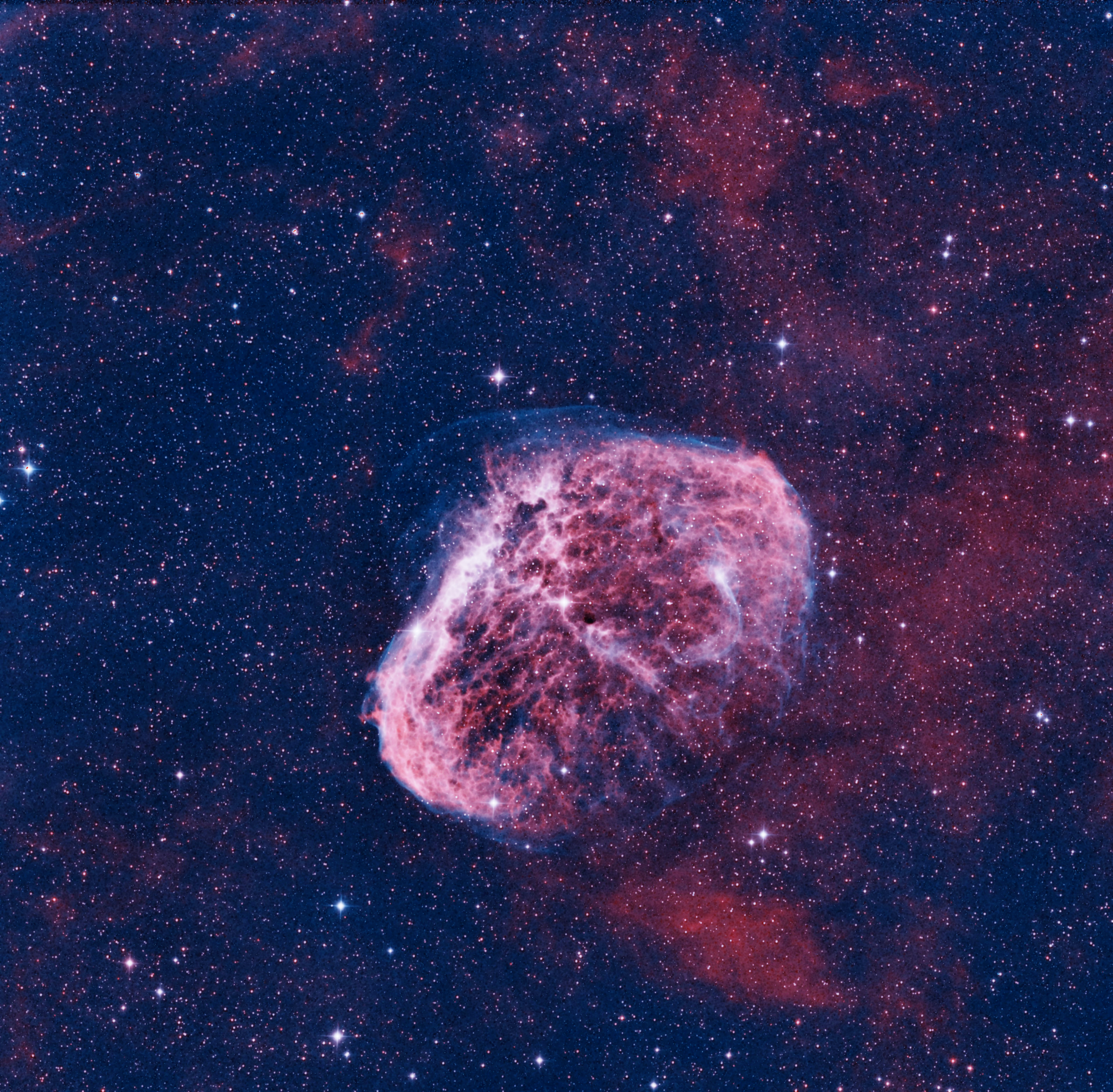
The Crescent Nebula, also known as NGC 6888, is a Emission Nebula in the constellation of Cygnus the Swan.
NGC stands for The New General Catalog of Nebulae and Clusters of Stars compiled by John Louis Emil Dreyer in 1888. Since then, the catalog has been updated and corrected. The last update occurred in 2019, containing 13957 objects.
An emission nebula is a cloud of gas that is energized and made to glow by a bright star at its center. The appearance of the nebula gave rise to the nickname Crescent (or Euro sign ) nebula. The two predominant colors (a deep red surrounded by a blue envelope) is due to two shockwaves caused by the bright star at its center and energizing Hydrogen gas in different ways.
The Crescent is about 5000 light-years away from Earth. It was discovered by William Herschel in 1792.
This image was obtained at the EKU’s Observatory, described elsewhere, during the nights of June 3 and June 4 2022.
Comments
to view and add comments.
Annotations
No one has annotated a text with this resource yet.
- typeImage
- created on
- file formatpng
- file size16 MB
- creatorMarco Ciocca
- publisherEastern Kentucky University
- publisher placeRichmond, KY
- restrictionsCreative Commons Attribution-NonCommercial-No Derivative Works 4.0 International License
- rightsCopyright © 2023 by Marco Ciocca. EKU Observatory Images is licensed under a Creative Commons Attribution-NonCommercial-No Derivative Works 4.0 International License, except where otherwise noted.